
Quick Answer: Local infrastructure gives businesses greater direct control and can provide strong performance for certain applications, while cloud infrastructure offers flexibility, remote access, and easier scalability. For many small and midsize businesses, the right solution is a hybrid approach that uses both based on the company’s needs.
Should your technology live in your office or in the cloud?
It’s a question many businesses face when replacing an aging server, adopting new applications, opening another location, or planning for future growth.
The answer isn’t necessarily one or the other.
What Is Local IT Infrastructure?
Local, or on-premises, infrastructure means your business owns and operates technology at your physical location. This might include servers, storage systems, network equipment, and applications that run locally.
Benefits of Local Infrastructure
Direct Control: Your business has greater control over the hardware, configuration, and where certain data is stored.
Performance: Applications that process large amounts of data locally may benefit from fast connections to onsite infrastructure.
Onsite Resources: Certain specialized or legacy applications may require a local server or other equipment to operate effectively.
But local infrastructure also requires hardware investment, maintenance, security, backups, and eventually replacement.
What Is Cloud Infrastructure?
Cloud infrastructure moves applications, storage, computing, or other technology resources to systems hosted outside your office and accessed through the Internet.
Microsoft 365 is one familiar example of businesses relying on cloud technology every day.
Benefits of Cloud Infrastructure
Remote Accessibility: Employees can securely access applications and information from different locations.
Scalability: Resources can often be increased or reduced as the business changes without purchasing new physical equipment.
Reduced Hardware Investment: Businesses may be able to reduce their reliance on onsite servers and the costs associated with maintaining and replacing them.
Cloud solutions aren’t maintenance-free, however. They still require proper configuration, security, access management, monitoring, and reliable Internet connectivity.
Local vs. Cloud: Which Costs Less?
There isn’t one answer for every business.
Local infrastructure may require a larger upfront investment in hardware, while cloud services often shift more technology spending toward ongoing subscriptions.
The better comparison is total cost over time, including:
- Hardware and replacement costs
- Cloud subscriptions
- Maintenance and support
- Backup and recovery
- Cybersecurity
- Internet connectivity
- Downtime risk
- Future growth
A solution that looks less expensive initially isn’t always the most cost-effective over its full lifecycle.
What Is Hybrid IT Infrastructure?
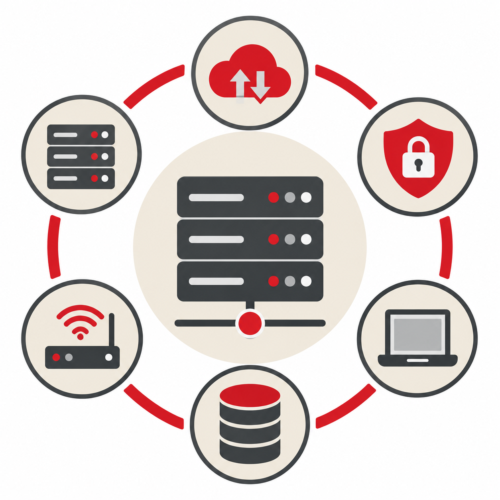
Hybrid infrastructure combines local and cloud technology.
For example, a business might keep a specialized application on a local server while using Microsoft 365, cloud backups, and other cloud-based applications.
This allows businesses to choose the environment that makes the most sense for each workload rather than forcing everything into one model.
Is Hybrid Infrastructure Best for Small Businesses?
For many SMBs, a hybrid environment can provide a practical balance of performance, flexibility, control, and resilience.
But hybrid isn’t automatically the right answer for everyone.
A business that operates almost entirely through cloud applications may need very little local infrastructure. Another company running specialized manufacturing, design, accounting, or industry-specific applications may still have an important need for onsite systems.
How Do You Choose Between Local and Cloud Infrastructure?
Instead of starting with “local or cloud?” start with your business requirements.
Consider:
- What applications does your business depend on?
- Where do employees work?
- How quickly are you growing?
- Are there performance or compliance requirements?
- What happens if your Internet connection goes down?
- What will your technology cost over the next several years?
- How quickly could you recover after a disruption?
Those answers should determine the technology, not the other way around.
Build Infrastructure Around Your Business
There is no universal winner in the local-versus-cloud debate.
The right infrastructure is the one that gives your business the performance, security, reliability, and flexibility it needs without unnecessary complexity or expense.
IT Radix helps businesses evaluate their current infrastructure and build a technology roadmap that makes sense for where they are today and where they’re headed next.
Because the goal isn’t to move everything to the cloud or keep everything onsite. It’s to put the right technology in the right place.