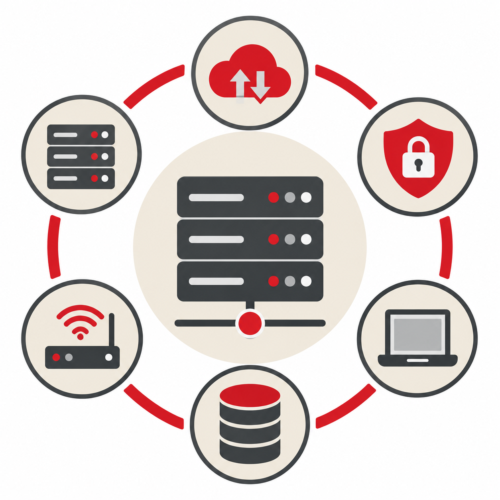
Quick Answer: Businesses can optimize their IT infrastructure by using business-grade equipment, eliminating single points of failure, automating maintenance, monitoring cloud resources, strengthening cybersecurity, and maintaining reliable backups. The goal isn’t necessarily to buy more technology. It’s to make the technology you depend on more reliable, secure, and efficient.
As a business grows, its technology often grows with it, but not always according to a plan.
A new application gets added here. Another employee needs a laptop there. More information moves to the cloud. Eventually, technology that worked perfectly well for a smaller organization may start creating performance, security, or reliability problems.
That’s when infrastructure optimization becomes important.
1. Use Business-Class Technology
The wireless router that works well at home isn’t necessarily designed to support an office full of employees, cloud applications, video meetings, printers, phones, and other connected devices.
Business-grade firewalls, switches, wireless access points, and other equipment provide better performance, security, management, and scalability.
That doesn’t mean buying the most expensive equipment available. It means choosing technology designed for how your business actually operates.
2. Eliminate Single Points of Failure
Ask yourself: What happens if this stops working?
If one Internet connection going down brings your entire company to a standstill, that’s a significant vulnerability.
Depending on your environment, redundancy might include:
- A secondary Internet connection
- Backup networking equipment
- Spare employee devices
- Redundant power protection
- Multiple ways to access critical systems
You don’t need two of everything. Focus on the technology whose failure would have the greatest impact on your business.
3. Automate Routine IT Maintenance
Important maintenance shouldn’t depend on someone remembering to do it.
Automating operating system updates, security patches, monitoring, alerts, and other routine tasks can help keep systems consistent and reduce the chance that something important gets overlooked.
Automation also gives your IT team more time to address issues that require actual investigation and planning.
4. Keep an Eye on Cloud Usage and Costs
Moving technology to the cloud doesn’t automatically make it more efficient or less expensive.
Unused accounts, unnecessary licenses, oversized resources, and forgotten services can quietly increase costs.
Regularly review:
- Cloud subscriptions
- Microsoft 365 licenses
- User accounts
- Storage usage
- Cloud computing resources
- Applications no longer being used
Optimization means making sure you’re paying for what your business actually needs.
5. Strengthen Access with Zero Trust Principles
Traditional security often assumed that anyone inside the company network could be trusted.
Modern businesses can’t rely on that assumption.
A Zero Trust approach follows a simple idea: verify users and devices before granting access to company resources.
For a small business, that can include multifactor authentication, strong access controls, device security, limited administrative privileges, and regularly reviewing who has access to what.
6. Protect Your Data
Optimized infrastructure still needs a strong recovery plan.
One commonly recommended approach is the 3-2-1 backup strategy:
- Keep three copies of important data
- Store those copies on two different types of media or systems
- Keep at least one copy separate from your primary environment
More importantly, backups should be monitored and tested. A backup you can’t restore isn’t much of a backup.
How Do You Know What to Optimize First?
You don’t have to overhaul your entire infrastructure at once.
Start by identifying the areas that create the greatest business risk:
- Aging equipment
- Recurring performance problems
- Unreliable Internet
- Missing security controls
- Failed or untested backups
- Unnecessary cloud spending
- Technology that can’t support future growth
From there, you can build a prioritized roadmap instead of replacing technology simply because it’s old or moving something to the cloud because it’s newer.
Better Infrastructure Starts with Better Planning
Optimizing your IT infrastructure isn’t about having the newest technology.
It’s about making sure your technology is reliable, secure, cost-effective, and capable of supporting where your business is headed next.
IT Radix helps small and midsize businesses evaluate their current infrastructure, identify weaknesses and opportunities, and build practical technology roadmaps for the future.
Because the best infrastructure isn’t necessarily the most complicated. It’s the infrastructure that works for your business.