
Quick Answer: Proactive IT support typically provides better long-term value than break-fix support because it helps identify problems before they cause costly downtime, improves security, and makes IT expenses more predictable. Break-fix may cost less when everything is working, but one significant outage can quickly erase those short-term savings.
For many small and midsize businesses, choosing between proactive IT support and traditional break-fix service seems to come down to one question:
Which one costs less?
At first glance, break-fix has an obvious appeal. If nothing breaks, you don’t receive a repair bill.
But the true cost of an IT problem isn’t limited to what you pay the technician. Downtime, lost productivity, interrupted customer service, security incidents, and emergency repairs all contribute to the final price tag.
That’s where the comparison gets interesting.
What Is Break-Fix IT Support?
Break-fix IT is exactly what it sounds like: something breaks, and you call someone to fix it.
A server crashes. An employee can’t access an application. The network goes down. Your IT provider diagnoses the problem, repairs it, and bills you for the work.
The advantage is lower ongoing IT spending when nothing goes wrong.
The tradeoff? Problems are usually discovered only after they’ve already affected the business.
That can mean:
- Unpredictable repair expenses
- Longer periods of downtime
- Emergency service costs
- Missed patches and maintenance
- Security vulnerabilities going unnoticed
In other words, you’re paying to solve problems rather than paying to help prevent them.
What Is Proactive IT Support?
Proactive IT support takes the opposite approach.
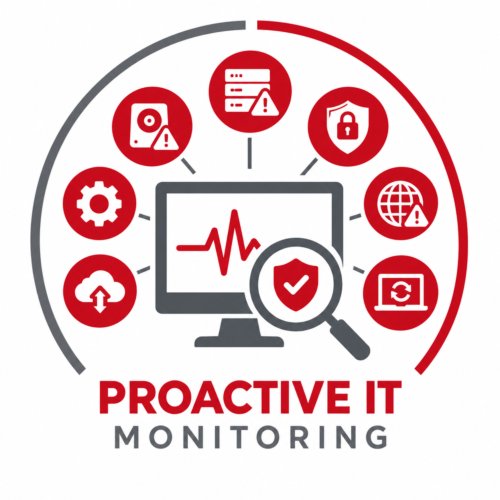
Instead of waiting for technology to fail, IT professionals continuously monitor and maintain your environment, looking for warning signs before employees are affected.
That can include monitoring hardware health, backups, network performance, security alerts, storage capacity, and software updates.
The goal isn’t to eliminate every IT problem. That’s impossible.
The goal is to catch more problems while they’re still small.
Proactive vs. Break-Fix IT: What’s the Difference?
| Break-Fix IT | Proactive IT |
|---|---|
| Responds after something breaks | Looks for problems before failure |
| Costs fluctuate | More predictable monthly costs |
| Limited ongoing maintenance | Continuous monitoring and maintenance |
| Problems often affect users first | Early warning signs may be detected |
| Greater potential for emergency repairs | Focuses on prevention |
| Reactive security approach | Ongoing security oversight |
What Does IT Downtime Really Cost?
Consider a business with 25 employees that experiences a four-hour server outage.
That’s potentially 100 hours of employee productivity affected before you even consider the IT repair itself.
Then add possible:
- Delayed customer service
- Missed sales opportunities
- Employee overtime
- Emergency IT support
- Recovery work
- Reputational damage
Suddenly, the cost of that outage isn’t just the technician’s invoice.
If proactive monitoring identifies an overheating server, failing hard drive, low storage capacity, or unsuccessful backup beforehand, IT may be able to address the problem before it becomes a four-hour emergency.
Not every outage can be prevented. But preventing even some of them can change the financial equation significantly.
Does Proactive IT Support Save Money?
For businesses that rely heavily on technology, proactive IT support generally offers greater long-term value.
You’re not necessarily paying less for IT every single month. Instead, you’re investing in fewer surprises, more predictable expenses, reduced downtime, and better-maintained technology.
It can also help businesses:
- Catch hardware problems earlier
- Keep security patches current
- Verify backups are working
- Improve system performance
- Strengthen cybersecurity
- Plan upgrades before equipment fails
That makes IT spending easier to budget and technology problems less disruptive.
Frequently Asked Questions
Is break-fix IT obsolete?
No. Break-fix support can still make sense in certain situations. However, businesses that depend heavily on technology often benefit from a proactive approach because downtime and security problems can have a much larger financial impact.
Can proactive monitoring prevent every IT problem?
No. Hardware can fail unexpectedly, employees can make mistakes, and cyberattacks can still occur. Proactive monitoring helps reduce risk and identify many warning signs earlier, but it can’t guarantee zero downtime.
Does proactive monitoring improve cybersecurity?
Yes. Monitoring can help identify unusual activity, missed patches, system vulnerabilities, and other warning signs. However, it should work alongside dedicated cybersecurity protections rather than replace them.
Is proactive IT support only for large companies?
No. Small and midsize businesses can benefit significantly, especially when they don’t have a large internal IT department monitoring their technology around the clock.
The Real Cost Is What Happens When Technology Stops
The question isn’t simply, “How much does IT support cost?”
A better question is, “How much does it cost our business when our technology doesn’t work?”
Break-fix support focuses on getting you back up and running after a problem occurs. Proactive IT support focuses on keeping you running in the first place.
At IT Radix, we believe preventing problems whenever possible is better than waiting for something to break. Proactive monitoring and maintenance help our clients reduce disruptions, control technology costs, and keep their teams focused on business instead of IT emergencies.